


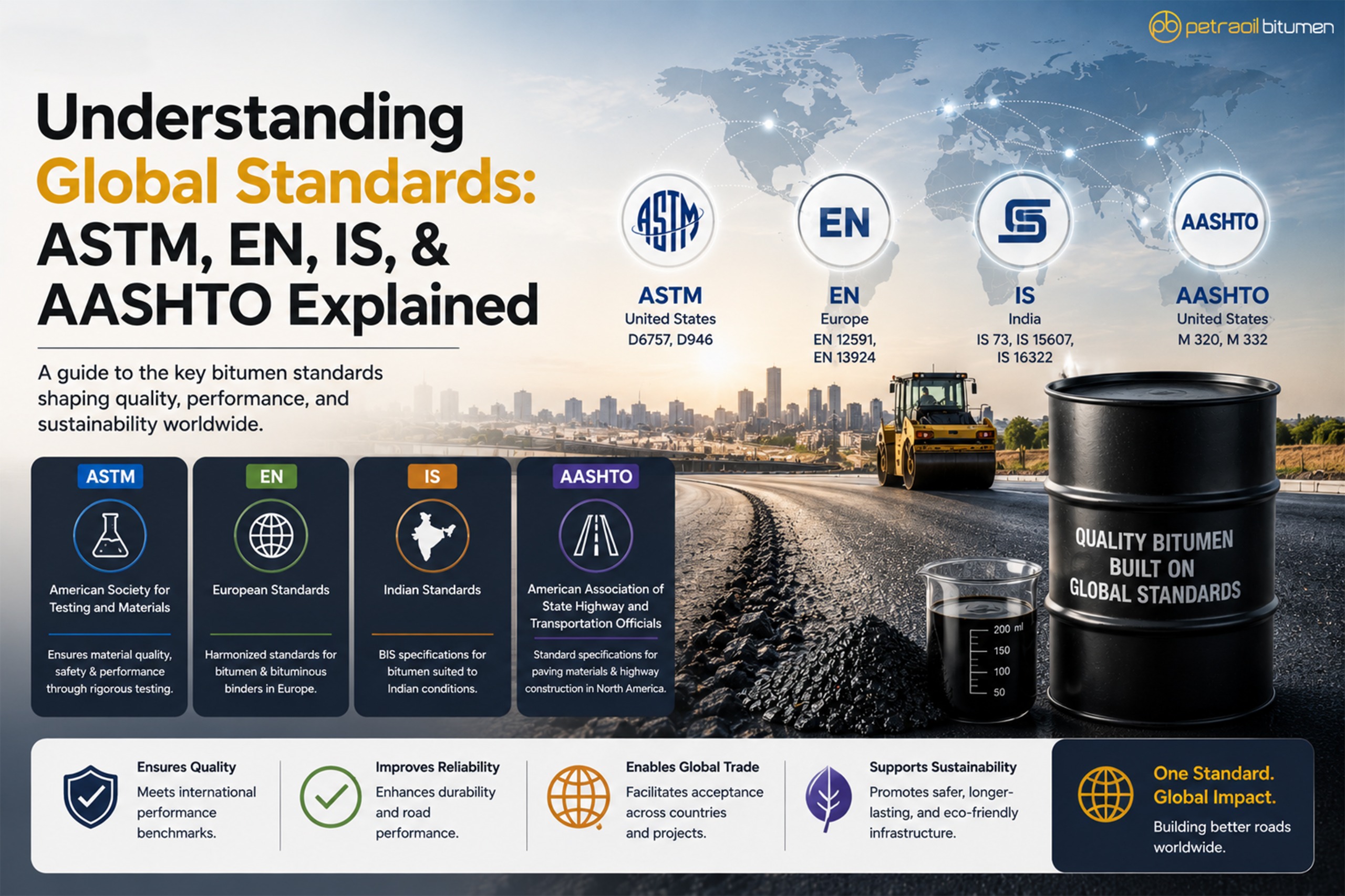
In today’s global construction industry, sourcing bitumen and other road construction materials usually means dealing with suppliers and contractors in different countries. While products may appear similar, the standards used to test, classify, and certify them can vary significantly.
This is where internationally recognized standards such as ASTM, EN, IS, and AASHTO become essential. These standards provide a common framework for the evaluation of material quality, testing procedures, safety and performance. Helping procurement managers, contractors, consultants and infrastructure developers understand them ensures they buy the right materials to meet the project specifications.
Why Standards Matter in Road Construction
Road infrastructure demands materials that can withstand various climates, heavy traffic loads, and long service lives. Even slight variations in the properties of bitumen can influence the durability, flexibility and resistance to deformation of the pavement.
International standards help ensure consistent product quality by standardizing laboratory testing methods, which improves compatibility between suppliers and buyers and ensures consistent product quality. It minimizes project risks and material failures and makes international trade easier.
Understanding the applicable standards is critical prior to procurement whether you are importing bitumen 60/70, polymer modified bitumen or bitumen emulsions
ASTM Standards Explained
ASTM International (formerly the American Society for Testing and Materials) is a U.S. based organization that develops globally recognized consensus based technical standards. It applies to thousands of manufacturing and industrial sectors, including petroleum and construction materials. It covers a wide range of materials, products, systems and services.
ASTM standards primarily focus on:
– Material specifications
– Laboratory testing methods
– Sampling procedures
– Performance evaluation
For bitumen, ASTM standards define important tests such as:
- Penetration Test: Measures the hardness or softness of paving bitumen.
- Softening Point Test: Determines the temperature at which bitumen begins to soften.
- Ductility Test: Evaluates how much the binder can stretch before breaking.
- Flash Point Test: Assesses safe handling temperatures during storage and transportation.
Because ASTM standards are widely accepted internationally, many export oriented bitumen manufacturers use ASTM testing to demonstrate product consistency.
EN Standards Explained
EN (European Norm) standards are developed by European standardization organizations and ratified by the European Committee for Standardization (CEN). It iswidely used across Europe to ensure consistent mechanical properties, environmental sustainability, and compatibility.
Unlike some standards that focus only on testing methods, EN standards primarily focus on:
– Performance based specifications
– Environmental considerations
– Sustainability
– Harmonized requirements across European markets
For bitumen products, EN standards cover:
- Road paving binders
- Polymer modified bitumen
- Bitumen emulsions
- Industrial bitumen applications
One major advantage of EN standards is their focus on long term pavement performance rather than only basic material properties. This approach aligns well with modern infrastructure projects where lifecycle cost analysis has become significantly important.
IS Standards Explained
Indian Standards (IS) are developed by the Bureau of Indian Standards (BIS) and serve as the primary quality benchmark for materials used throughout India. These codes are tailored specifically to Indian climatic conditions, construction practices, raw materials, and safety regulations.
IS standards are particularly important for:
– National highway projects
– State road departments
– Municipal infrastructure
– Government procurement
Common IS standards cover:
- Paving bitumen grades
- Bitumen emulsions
- Cutback bitumen
- Testing procedures
- Storage and handling requirements
Because India’s climate ranges from extremely hot deserts to cold mountainous regions and monsoon corridors, IS standards help ensure materials are suitable for diverse environmental conditions. Many infrastructure tenders within India specifically require compliance with BIS specifications.
AASHTO Standards Explained
AASHTO stands for the American Association of State Highway and Transportation Officials. Unlike ASTM, which primarily develops testing standards, AASHTO focuses on transportation engineering, highway construction, and pavement design. Its standards are highly specialized for the design, construction, and material testing of highways, bridges, and public transportation.
AASHTO standards include:
– Material specifications
– Highway design guidelines
– Pavement performance criteria
– Construction practices
– Quality assurance procedures
One notable contribution from AASHTO is the Performance Grade (PG) Bitumen system. Instead of classifying bitumen solely by penetration grade, the PG system evaluates performance across expected temperature ranges, making it especially useful for modern highway engineering.
Today, many countries reference AASHTO guidance when designing high performance pavements.
ASTM vs EN vs IS vs AASHTO
Standard | Primary region | Main focus | Typical use | Unit of measurement | Development |
ASTM | Global/North America | Material testing and specifications | Product quality verification | Imperial and SI | Global consensus process with multi-industry stakeholders. |
EN | Europe | Performance and harmonized specifications | European infrastructure projects | Only SI | Consensus by European technical committees. |
IS | India | National infrastructure, industrial goods, and localized compliance | Indian public and private projects | SI | Formulated strictly by the Bureau of Indian Standards. |
AASHTO | United States | Highway engineering and pavement design | Transportation infrastructure | Imperial and SI | Developed by state and federal transportation officials. |
Although these standards have different origins, they often complement one another rather than compete.
A project may specify ASTM testing methods while also requiring compliance with AASHTO pavement design criteria or local IS specifications.
Which Standard Should Buyers Follow?
The correct standard depends on several factors:
Project Location: Government infrastructure projects usually specify the required national standard.
Client Requirements: International EPC contractors may request ASTM or EN compliance regardless of project location.
Export Markets: Bitumen exporters often certify products using internationally recognized ASTM methods to satisfy overseas customers.
Performance Requirements: For demanding applications such as airports, expressways, or heavy industrial roads, AASHTO or EN performance based standards may be preferred.
Understanding customer expectations before procurement helps avoid costly delays and rejected shipments.
Conclusion
ASTM, EN, IS and AASHTO all have a vital role to play in guaranteeing the quality, safety and performance of construction materials used throughout the world. They vary in their focus- Testing methods, performance specifications, national regulations, or highway engineering; all contribute to building reliable infrastructure.
For contractors, procurement managers, and infrastructure developers, understanding these standards helps to facilitate supplier evaluation, reduce procurement risks and ensure compliance with project requirements. As infrastructure projects become increasingly global, knowing multiple standards is no longer a choice, it’s a competitive edge.
The right supplier is an important decision, from ASTM, EN, IS and AASHTO specifications to project specific requirements. At Petraoil we provide certified quality, consistent production and expert technical support to make sure your infrastructure projects are built to last. Get in touch with our team to learn more about what standard(s) would be best suited to your project needs.
