


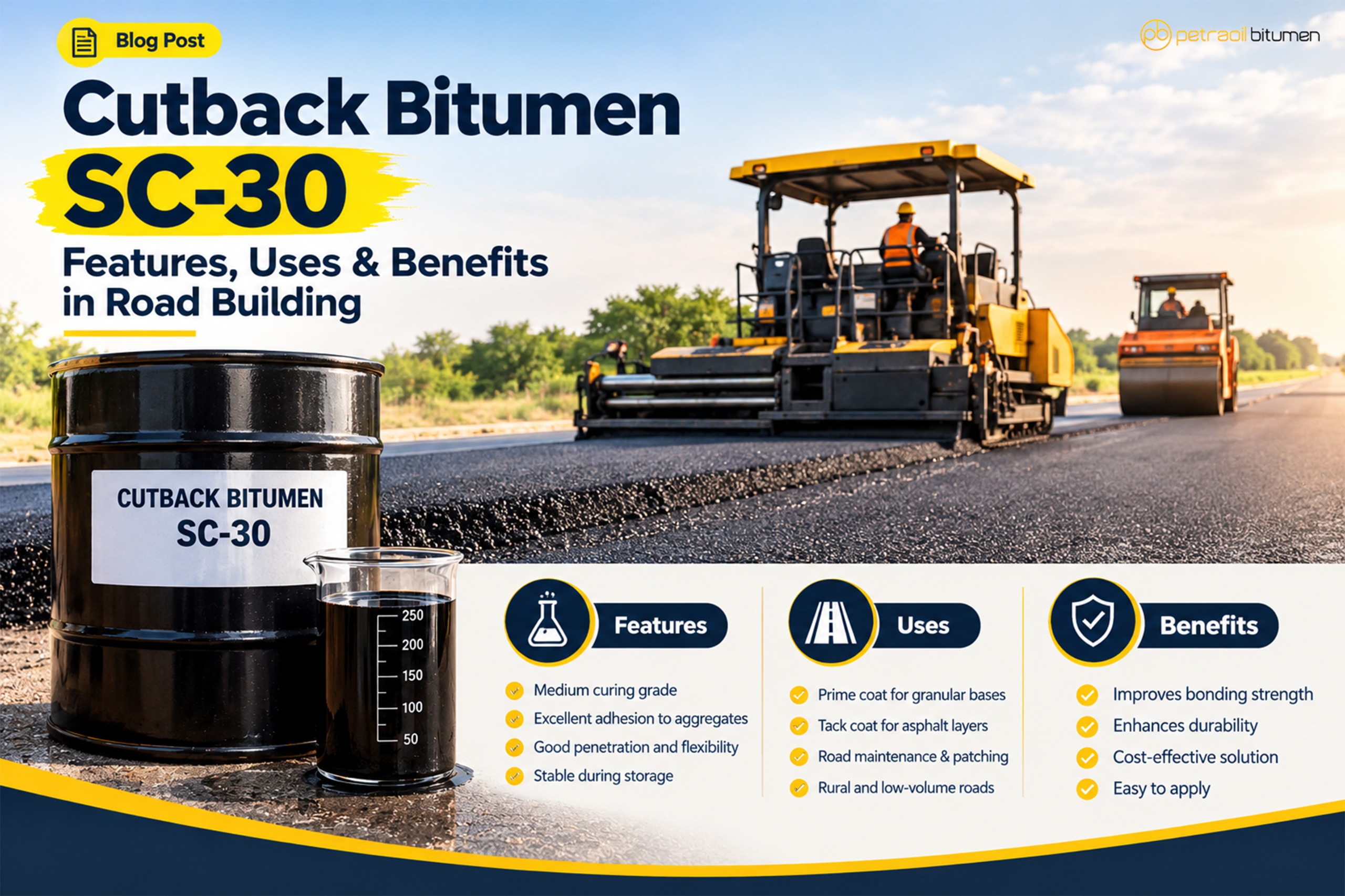
Suitable bituminous materials are essential for road construction projects to its method of application, surface condition, and performance requirements. In some applications the desirable binder is less viscous than conventional paving grade bitumen, to facilitate handling and distribution without excessive heating.
Cutback bitumen SC-30 is a slow curing asphalt binder with a suitable petroleum based diluent added to improve workability. Due to its low viscosity, it can be used for certain road construction and maintenance operations.
It is important for contractors, engineers, and procurement specialists to know the properties, applications, and limitations of SC-30 bitumen so that they can be able to decide if it is suitable.
What is SC-30 Cutback Bitumen?
Cutback bitumen SC-30 is a reduced viscosity asphalt binder based on petroleum with a suitable diluent. It is a member of the slow curing (SC) family of cutback bitumen and cures slowly as the diluent evaporates or is absorbed by the surrounding material.
SC-30 is a slow curing cutback bitumen of a particular viscosity grade. The number is the nominal viscosity classification of the grade not the penetration value, curing temperature or application temperature.
Slow curing cutback bitumen can be easier to work with at a lower handling temperature than conventional paving grade bitumen which normally needs to be heated until it reaches a suitable application viscosity, depending upon the formulation and site conditions.
The curing process allows the material to form a progressively more viscous asphalt residue. But this curing time is dependent on ambient temperature, thickness of application, ventilation, and diluent characteristics.
SC-30 is not to be confused with rapid curing (RC) or medium curing (MC) cutback grades. These classifications are characterised by the diluent’s volatility and by the cure characteristics.
Key Properties of SC-30 Cutback Bitumen
The performance of SC-30 bitumen is highly dependent on its viscosity, curing behaviour, composition, and compatibility with the construction method for which it is intended.
Workability and Viscosity
SC-30 is a low viscosity cutback grade and can be useful in applications where a more fluid binder is required. However, the grade designation alone does not determine suitability for all applications, and the viscosity should be evaluated at the temperature specified in the relevant testing standard.
Slow Curing Properties
The slow curing behaviour of SC-30 gives more time for distribution, mixing and coating of the material before the binder becomes more viscous.
This is advantageous in long working time operations but may extend the subsequent construction activity in cool or poorly ventilated conditions.
Adhesion and Coating
If the material and method of construction are compatible, SC-30 cutback asphalt can give sufficient coating to suitable mineral aggregates.
The strength of this bond is a function of the properties of the aggregate, the cleanliness of the surface, the moisture conditions, and the properties of the asphalt residue.
Temperature Sensitivity
The temperatures of the ambient and the material influence the viscosity, the application behaviour, and the curing of bitumen.
The higher the temperature, the faster the diluent will evaporate, the lower the temperature, the longer the cure time. The application temperatures must thus comply with the project specifications and handling recommendations of the supplier.
SC-30 Bitumen for Road Construction Applications
The SC-30 is used primarily for road construction and maintenance operations where a workable, slow curing asphalt binder is required.
Mixing Roads and Coating Aggregates
One application of slow curing bitumen in road construction is in the manufacture of certain road mixed asphaltic materials. The lower viscosity of SC-30 may ease the coating of the aggregate during mixing operations. The slow curing properties of this material allow more working and distributing and compacting time for the mixture.
Suitability shall be based on the aggregate grading, moisture content, construction conditions, and the requirements of the approved mix design.
Dust Control & Surface Treatments
SC-30 may be used for some dust control or surface treatment purposes on unpaved roads. The fluid binder can be applied on suitable surfaces, but the effectiveness depends on the rate of application, surface preparation, traffic conditions, and curing.
The use of solvent borne products is subject to project specific assessment, particularly in cases where environmental constraints limit their use.
Pavement Maintenance Operations
SC-30 may also be used in some maintenance operations where a low viscosity binder with an extended working time is required. However, it should not be automatically considered as a substitute for conventional prime coats, tack coats, or asphalt emulsions. The appropriate material shall be selected according to relevant construction specification.
Advantages and Disadvantages of SC-30 Cutback Bitumen
The primary advantages of SC-30 are its workability and gradual cure properties. Benefits include:
- Improved workability: Reduced viscosity allows easier handling and spreading in relevant applications related to construction.
- Longer working time: Slow curing may give more time for mixing and coating of aggregate.
- Reduced handling temperatures: Applications may require less heat than conventional paving grade bitumen.
- Application flexibility: The SC-30 could be considered for selected road mixing, surface treatment, and maintenance operations.
These benefits must be balanced with operational constraints.
SC-30 contains petroleum based diluents that will release volatile organic compounds during application and curing resulting in environmental, occupational safety and regulatory considerations.
Slow curing can also increase the time before the treated materials are ready for exposure to subsequent construction or traffic.
Therefore, the use of SC-30 is not always preferred over asphalt emulsions or other cutback grades, and the material selection should be based on project specifications, environmental requirements, and construction schedules.
Technical specifications and purchase considerations
For international buyers, choosing cutback SC-30 means more than just ticking the product name. Check technical documentation and application requirements before purchasing.
Technical Specifications and Quality Control
Relevant quality parameters could include:
- Viscosity at specified test temperatures
- Distillation characteristics
- Flash point
- Properties of residue post distillation
- Solubility and other parameters as required by the applicable specification
Acceptance limits and testing procedures are subject to the applicable standard and buyers should ask for the technical data sheet and check the compliance with the specifications relevant to their project.
Where required, obtain batch specific test reports or certificates of analysis.
Packaging, Transport, and Storage
When selecting the package, order quantities, unloading facilities, transportation methods and local handling requirements should be taken into consideration.
Storage containers shall be appropriate for petroleum based cutback materials and protected from contamination. Handling procedures should consider the flash point of the product, ventilation requirements, and potential exposure to ignition sources.
Storage, transport, and occupational exposure measures must be in accordance with the supplier’s safety data sheet.
Supplier Assessment
Procurement teams should confirm product specifications, availability of documentation, packaging options, and delivery requirements before placing an order. Costs for logistics and procurement can also include the shipping schedule, the regulations of the destination, and any dangerous goods classifications of the imported materials.
Early clarification of these requirements will mitigate the risk of material rejection, delivery problems, and construction delays.
Conclusion:
Cutback bitumen SC-30 is a slow curing asphalt binder that is used in certain applications in road construction and maintenance where reduced viscosity and extended working time are desired. Its properties can support aggregate coating, road mixing operations, and specified surface treatments.
However, the successful application depends upon appropriate material selection, construction conditions, curing requirements, and compliance with relevant technical specifications.
Contractors and procurement professionals need to assess viscosity, residue characteristics, quality documentation, and handling requirements before selecting a supplier.
Finally, the cutback bitumen SC-30 should be selected based on the proven project specifications and not only on the grade designation. The specification driven procurement approach allows for more consistent material selection and construction planning.
Need a dependable sourcing partner for cutback bitumen SC-30? Petra Oil Bitumen can assist you with your product questions and sourcing needs. Talk to the team about your project specifications, packaging preferences, and supply requirements.
