


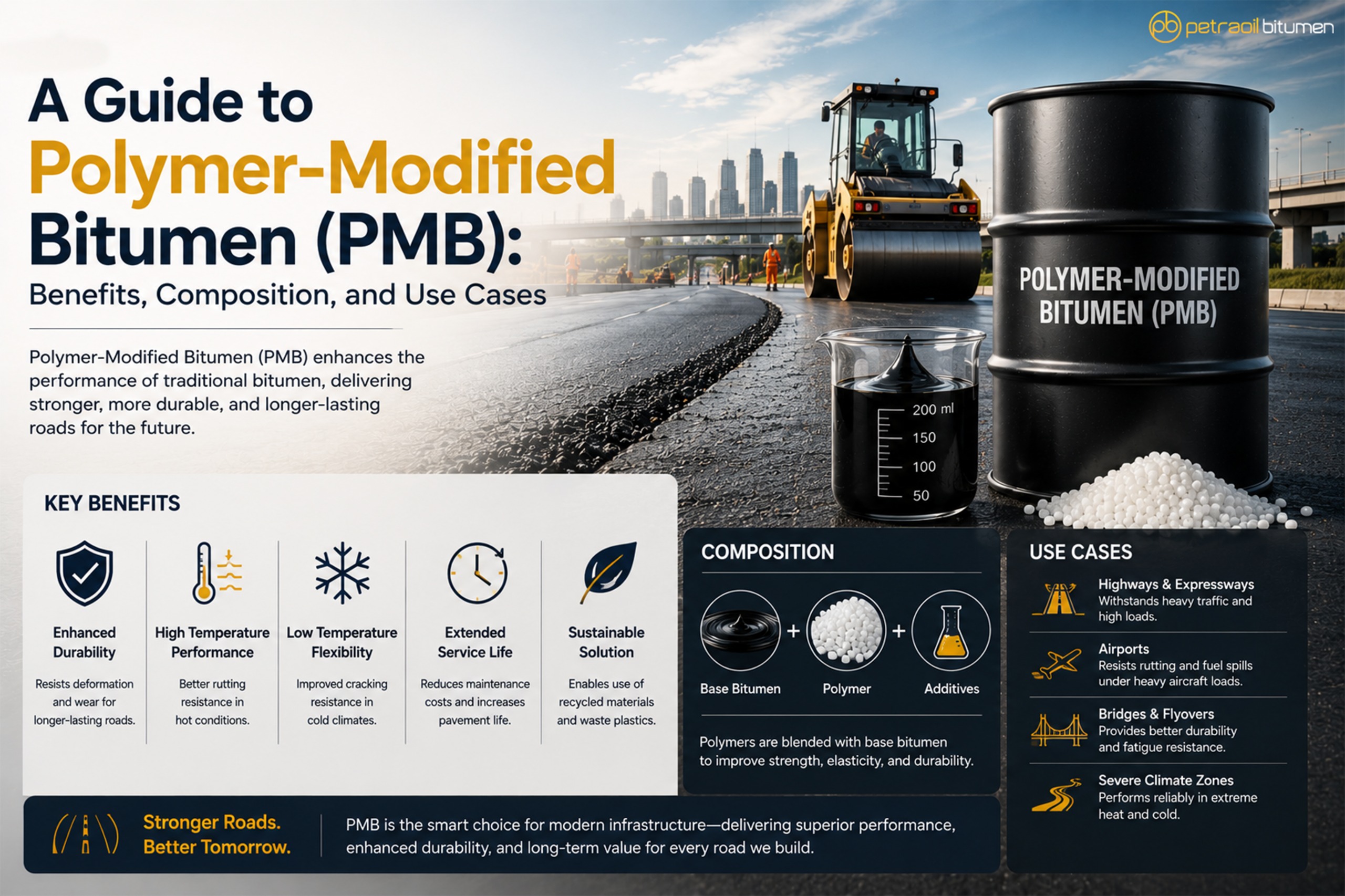
As infrastructure projects grow larger, more demanding and expected to last longer, traditional paving materials are often stretched to their limits. Today roads must cope with heavier axle loads, increased traffic volumes, extreme weather and increased maintenance expectations. To overcome these challenges, many governments, contractors and infrastructure developers are now turning to Polymer-Modified Bitumen (PMB) as a high-performance alternative to traditional paving bitumen.
PMB uses specially designed polymers to improve the physical properties of bitumen for greater durability, flexibility and resistance to deformation. It is the binder of choice for highways, airports, bridges, urban streets and other high stress applications where long-term performance is required.
What Is Polymer-Modified Bitumen (PMB)?
Polymer-Modified Bitumen (PMB) is a specially formulated bituminous binder, produced by blending performance enhancing polymers into conventional paving bitumen. These polymers enhance the mechanical properties of the binder enabling it to perform better in both high and low temperature conditions.
Compared to standard bitumen, PMB offers improved elasticity, higher resistance to permanent deformation, better fatigue performance, and enhanced adhesion with aggregates.
Depending on the project requirements, different polymer types can be utilised to achieve specific performance characteristics, such as:
• Elastomeric polymers for enhanced flexibility and crack resistance
• Plastomeric polymers for higher stiffness and rutting resistance
• Specialty additives for durability and ageing resistance
The result is a binder specifically designed for roads subjected to demanding traffic and environmental conditions.
How Polymer-Modified Bitumen Is Manufactured
The manufacturing process consists of mixing selected polymers with heated bitumen at controlled temperatures in high shear mixing equipment.
The production process generally includes:
- Selection of a proper base bitumen.
- Heating the bitumen to the necessary processing temperature.
- Introducing polymers gradually during continuous mixing.
- Controlled blending conditions to ensure uniform distribution.
- Quality testing to ensure compliance with applicable standards.
Consistent manufacturing is vital, because the performance of PMB is dependent on the even distribution of the polymers throughout the binder.
Key Benefits of Polymer-Modified Bitumen
Enhanced rutting resistance
Heavy traffic loading can result in conventional pavements deforming into wheel path depressions or rutting.
PMB greatly enhances the stiffness of the pavement at high temperatures, thus limiting the permanent deformation and allowing the roads to keep their structural integrity under heavy loads.
Hence PMB is especially suited for highways, freight corridors, intersections and industrial roads.
Better Crack Resistance
Temperature fluctuations cause pavements to expand and contract, eventually resulting in cracks. The elastic properties of PMB allow for reduction of stresses in pavements, resulting in less thermal cracking and better fatigue life of the pavements in future traffic cycles. This translates into longer pavement life with fewer repairs.
Improved Durability
One of the biggest advantages of Polymer-Modified Bitumen is its ability to extend pavement service life. Compared with conventional binders, PMB resists:
- Oxidation
- Weathering
- Moisture damage
- Mechanical fatigue
Longer lasting roads mean lower maintenance requirements and reduced lifecycle costs.
Superior Adhesion
PMB provides stronger bonding between the bitumen binder and aggregates.
Improved adhesion reduces the risk of stripping from water infiltration, so pavements stay intact even in long periods of rain or humid conditions.
This is particularly important in tropical and coastal environments.
Enhanced Temperature Performance
Roads are often exposed to both extreme heat and cooler temperatures.
PMB performs effectively across a wider temperature range by:
- Being flexible during colder conditions
- Maintaining stability during hot weather
- Bleeding control at high temperatures
- Reducing low temperature brittleness
The balanced performance of PMB makes it suitable for different climatic conditions.
Understanding Common PMB Grades
Different infrastructure projects require different binder properties. Selecting the proper PMB grade helps ensure optimum pavement performance.
PMB 10/40-65
PMB 10/40-65 is frequently chosen for high-performance road construction requiring excellent resistance to rutting and durability.
Typical applications include:
- Expressways
- National highways
- Heavy-duty freight corridors
- Airport pavements
- Urban arterial roads
It’s greater elasticity and rigidity help the pavement to endure heavy traffic without compromising structural integrity.
PMB 25/55-65
PMB 25/55-65 offers an excellent balance between flexibility and strength which is essential for projects under varying traffic loading and environmental conditions.
Common applications include:
- Urban road networks
- Municipal infrastructure
- Bridges and flyovers
- Commercial developments
- Regional highways
Its performance properties help reduce cracking and provide excellent long term durability.
Common Applications of Polymer-Modified Bitumen
PMB has become an essential material across many infrastructure sectors.
Typical applications are:
Highways and Expressways
High speed roads subjected to continuous heavy traffic require binders that are resistant to rutting and fatigue over long service lives.
Airport Runways
Aircraft have very high wheel loads during landing and take-off. PMB helps resist deformation and maintain pavement stability
Bridges and Flyovers
Bridge decks experience greater movement due to structural expansion and contraction. PMB’s flexibility helps accommodate these stresses while reducing cracking.
Industrial Roads
Ports, logistics centres, and manufacturing facilities experience concentrated heavy vehicle traffic. PMB delivers the endurance needed for these extreme environments.
Urban Roads
Busy city roads subjected to constant braking, turning, and congestion benefit from PMB’s improved resistance to deformation and wear.
Why PMB Is a Cost-Effective Investment
Although Polymer-Modified Bitumen generally has a higher initial cost than conventional bitumen, its long-term value often outweighs the upfront investment.
Benefits include:
- Reduced maintenance frequency
- Lower repair costs
- Extended pavement life
- Improved ride quality
- Fewer traffic disruptions during maintenance
- Better lifecycle cost efficiency
These advantages translate into lower total costs of ownership for government agencies, contractors and asset owners over the life of the pavement.
Conclusion
Polymer-Modified Bitumen has become an important element of modern pavement engineering as infrastructure projects continue to demand higher performance and longer service life. PMB combines traditional bitumen with high polymer technology to provide superior resistance to rutting, cracking, ageing and moisture damage and improves overall durability of the pavement.
Selecting the right Polymer-Modified Bitumen grade, such as PMB 10/40-65 for heavy-duty highways and PMB 25/55-65 for urban infrastructure, can significantly enhance pavement performance and lower lifecycle costs.
PMB is a smart investment for contractors, consultants, procurement managers and infrastructure developers looking for reliable, high-performance paving solutions for durable, sustainable road construction.
Call-to-Action
Looking for Polymer-Modified Bitumen for your next infrastructure project? Get in touch with our team at Petraoil Bitumen to find the right PMB grade, packaging and supply solutions for your project needs. Our experts are ready to help you achieve long lasting pavements with quality PMB products.
