


Road construction and pavement maintenance require bituminous materials with appropriate bonding capabilities and working properties. Choosing the right asphalt emulsion affects multiple aspects of the process.
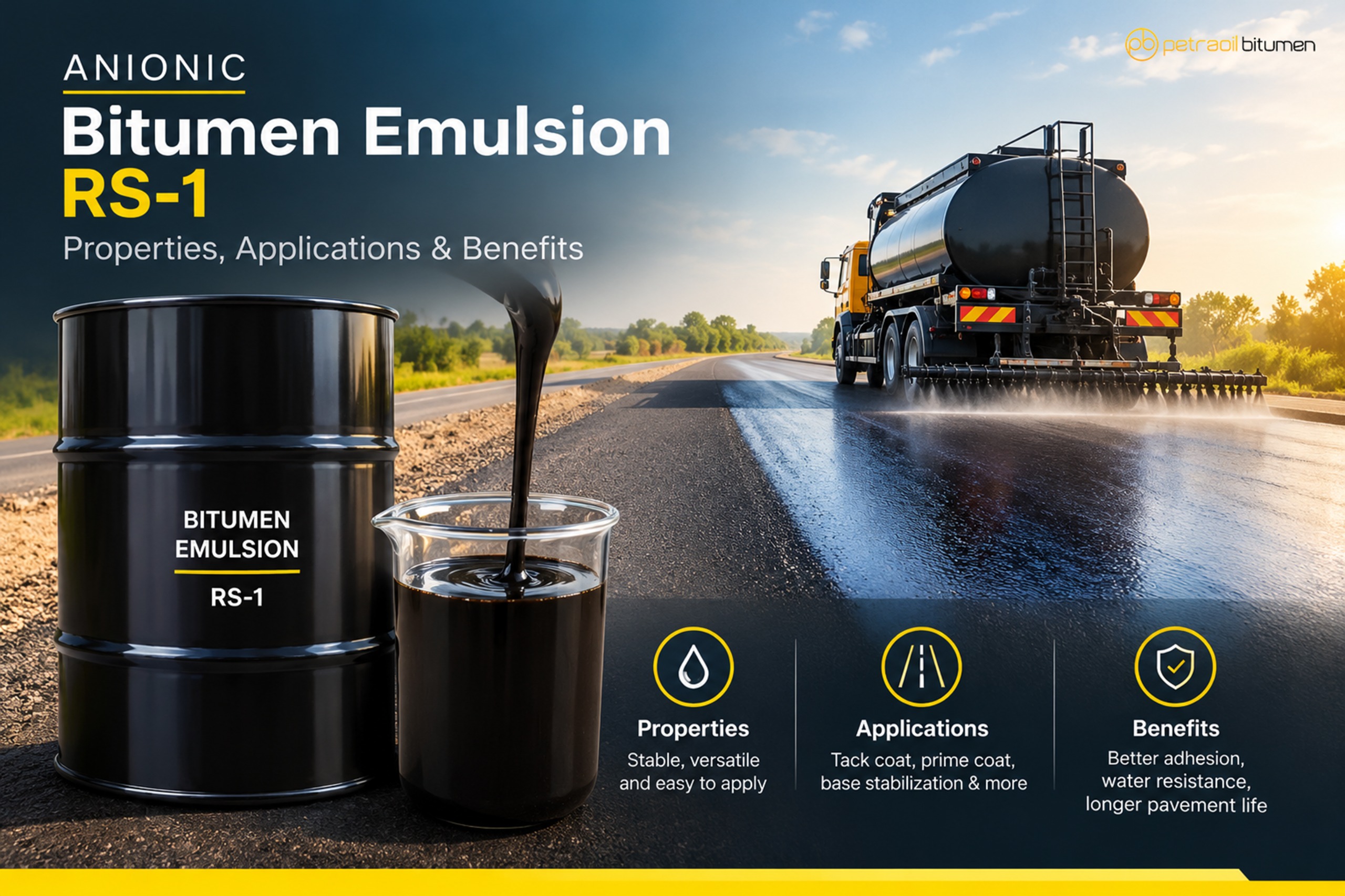
Anionic bitumen emulsion RS-1is a water based, rapid setting asphalt emulsion used in selected road construction and pavement maintenance applications. This product enables asphalt application at lower temperatures than conventional hot bitumen, depending on the project’s requirements.
For contractors, engineers, and procurement teams, understanding the technical data, applications and technical requirements is essential when considering this grade for a project.
What Is Anionic Bitumen Emulsion RS-1?
Anionic bitumen emulsion RS-1 is a mixture of minute asphalt droplets with a negative electric charge suspended in water and a stabilising emulsifying agent.
The name RS stands for rapid setting, which characterises this type of bitumen emulsion. This property means that when the emulsifying action is complete, the asphalt binder droplets join to form a continuous layer. In other words, the mix hardens and becomes solid, so it can no longer be used.
It should be noted that anionic charges are not the only possible ones. In fact, this classification exists for cationic emulsions, which have positively charged asphalt particles.
However, the RS grade does not automatically indicate the viscosity, bitumen content, and other performance characteristics of the material. These specifications may vary, depending on the standards in force in a specific country.
Properties and Benefits of Anionic Bitumen Emulsion RS-1
Various properties define the technical characteristics of anionic bitumen emulsion RS-1.
- Rapid setting: RS-1 grade has a set of properties that enable it to set quickly under specific conditions.
- Less heat needed: Because this asphalt binder is water-based, the required application temperature is lower compared to conventional hot bitumen.
- Uniform coating: The mixture is suitable for spraying on aggregate under appropriate conditions.
- Adhesion to mineral surfaces: This bitumen emulsion provides good bonding, but this characteristic depends on mineralogical composition, moisture content, and other factors.
- Low percentage of organic solvents: Emulsions are suspensions of asphalt droplets in water, unlike cutback bitumen. It is entirely possible to reduce the amount of petrolatum in construction.
These advantages are associated with the technical specifications of the asphalt emulsion. It is important to remember that rapid-setting grade RS is not suitable for all applications.
RS-1 Emulsion Applications in Road Construction
Depending on the technical specifications, RS-1 bitumen emulsion can be used in several types of road construction.
Surface Dressing and Chip Sealing
In road construction, rapid setting emulsions are often used for surface dressing and chip sealing. They are applied to a road surface, followed by the even distribution of stone or gravel. The proper selection of this grade should be based on a laboratory’s recommendations, traffic conditions, and other factors.
Tack Coat Applications
The specification includes RS-1 emulsions for tack coat applications for bonding two layers of bitumen surfacing. In this case, it is important to ensure that the surfaces are properly prepared, and the binder is distributed evenly.
Pavement Maintenance
In addition, anionic bitumen emulsion can be used for selected types of pavement maintenance. It should be emphasised that emulsions with rapid setting characteristics are suitable for short time mixing with aggregates. For this reason, they cannot be used for chip sealing and other road construction activities that require a certain period of tamping.
Technical Specifications and Quality Requirements
Before using the Rs-1 emulsion, it is necessary to ensure that the purchased product meets the relevant technical specifications. Therefore, it is important to obtain the relevant documents and compare the indicated indicators with the declared requirements for this type of work.
Viscosity indicates how the asphalt binder will behave during transport, storage, and application. It is indicated by the letter “P” (asphalt binder) and the number indicating the viscosity class.
The bitumen residue refers to the amount of asphalt binder left after the separation process. This characteristic determines the binding ability of the material.
The particle charge confirms that this binder is an anionic bitumen emulsion. The main test is the sieve test, which detects large particles of binder that indicate improper preparation of the construction material.
It is also necessary to ensure that the material is suitable for repeated use and does not cause premature termination of work due to improper storage. A list of quality indices can be found in the technical specification for the selected type of emulsion.
Selection, Procurement and Storage Considerations
When selecting anionic bitumen emulsion RS-1, the focus should be on those technical indicators that ensure the quality of the finished pavement. Attention should be paid to the composition and viscosity, as these factors ensure the workability of the material when used. The choice of this type of binder is influenced by a number of factors, including:
- The project’s particular requirements.
- The ability of the chosen material to bind the aggregate.
- Working conditions and the season.
- Technical characteristics and safety data sheet.
- Packaging and transportation conditions.
Asphalt emulsions should not be frozen, heated or contaminated with foreign substances. In addition, compliance with the recommended storage temperature is important. In some cases, during transport, the binder can be subjected to prolonged stress, which requires additional testing of the quality of this material.
Conclusion
Anionic bitumen emulsion RS-1 is a construction material that is used in road construction works where it is necessary to obtain a rapid setting mix. Despite the advantages of water based bitumen emulsions, the choice of this grade should be made regarding the type of mineral aggregate, working conditions and other factors.
When sourcing, it is necessary to ensure that the product meets the specified technical specifications. In addition, it is important to store this material in compliance with the relevant temperature conditions and consider other factors that may affect the integrity of the asphalt binder.
Looking for anionic bitumen emulsion RS-1? Petra Oil Bitumen offers a wide range of products, including bitumen emulsions. Contact our experienced team to discuss your project, learn more about the product and get a quote.
