


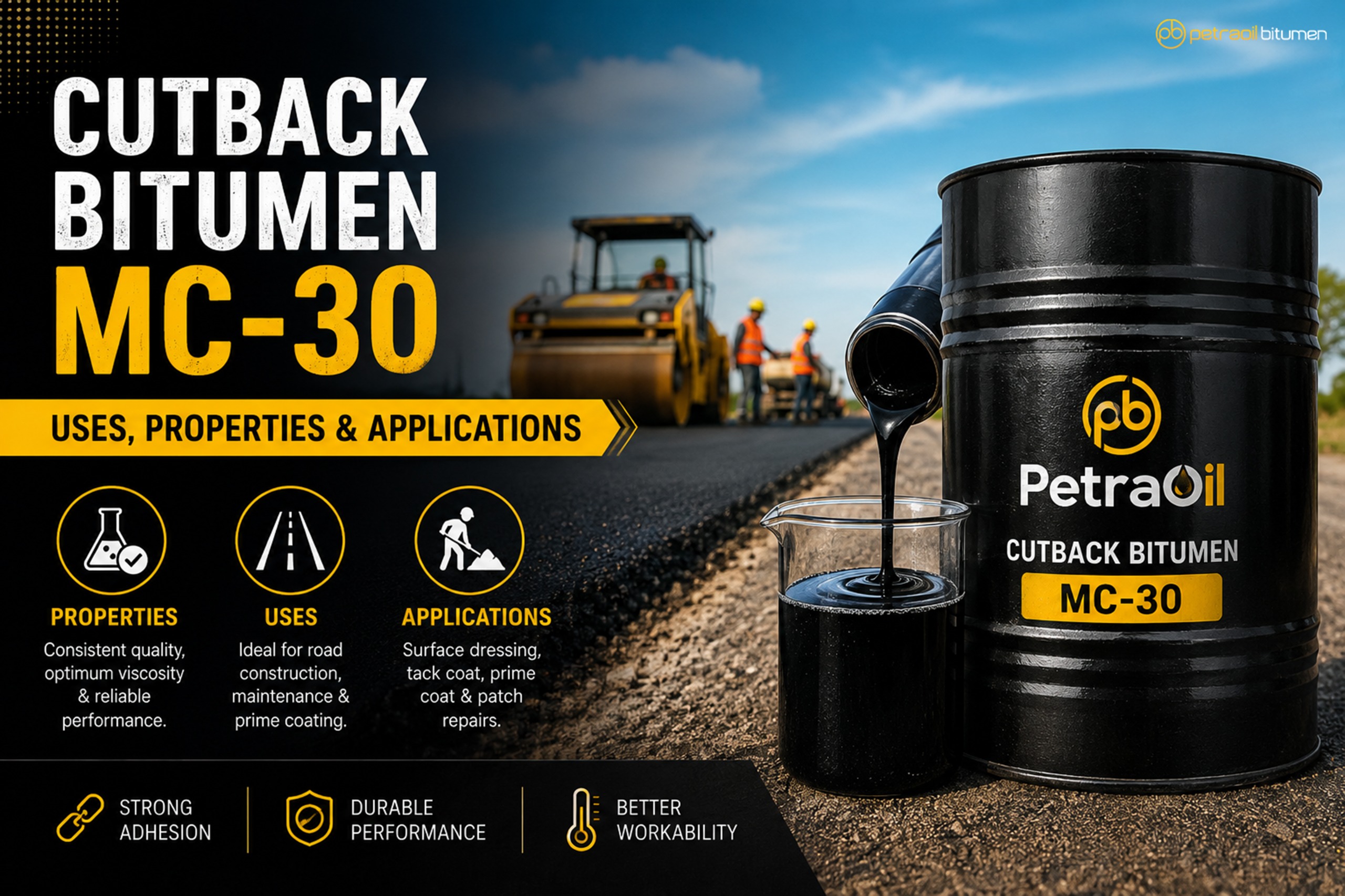
Road building materials need to be workable, adhesive and high performing, especially when contractors are operating on granular bases or where conditions make heating bitumen less viable in the normal way. Cutback bitumen MC-30 can be useful here. MC-30 is a medium curing cutback asphalt in which the viscosity of the bitumen is reduced using a suitable petroleum diluent. This allows the binder to flow and penetrate more freely before the gradual evaporation of the diluent.
Understanding how MC-30 operates is critical for contractors, engineers and procurement teams when selecting material for priming, surface treatment and other pavement-related applications.
What is Cutback Bitumen MC-30?
MC-30 cutback bitumen is a medium curing cutback asphalt used in the construction and treatment of pavements. Cutback bitumen, unlike ordinary paving grade bitumen, contains a petroleum diluent or “cutter”. The diluent temporarily reduces the viscosity of the asphalt, making the material easier to handle and apply. After application, the cutter evaporates gradually, and the remaining asphalt binder performs the intended binding function.
The “MC” stands for medium curing, and the “30” is the viscosity grade. The kinematic viscosity of MC-30 is around 30–60 mm²/s at 60°C (140°F) under commonly cited ASTM specifications. This relatively low viscosity is one of the reasons why MC-30 bitumen is generally associated with prime coat applications.
How do you cure MC-30?
The curing process takes place as the volatile diluent evaporates from the applied material. As the cutter evaporates, the asphalt residue becomes more viscous and gains the binding properties required for the application.
Temperature, meteorological conditions, ventilation, surface properties and application conditions affect the rate of curing. Therefore, rather than assuming a predetermined curing time, contractors should refer to the project specification and the product technical data sheet.
MC-30 Bitumen – Properties, Uses and Applications
The performance of medium-curing cutback bitumen depends on the characteristics of the asphalt residue and the behaviour of the diluent. The most crucial thing for the buyer is that the product should be tested according to the specification required for the project and not only on its commercial grade designation.
MC-30 Key Properties
Commonly cited ASTM based requirements include:
- Kinematic viscosity at 60°C: 30–60 mm²/s.
- Flash point: normally a minimum of approximately 38°C.
- Residue from distillation: 50% by volume minimum.
- Water content: normally restricted to 0.2%.
- Residue tests: may include penetration, ductility and solubility tests.
- Penetration at 25°C: 120–300 dmm.
These values should be used as specification references only and not as universal product warranties. Always check the applicable standard, contract specification and current supplier’s certificate of analysis before you buy.
MC-30 Bitumen Applications
One of the better-known uses of MC-30 bitumen is as a prime coat on suitable granular pavement substrates. A prime coat is designed to penetrate and bind the upper part of a granular base and to prepare the surface for the application of a subsequent bituminous layer.
Depending on the project specification and formulation, MC-30 can also be considered for applications such as:
- Prime coating – preparing granular or crushed stone bases prior to asphalt paving.
- Surface treatment – when the treatment is prescribed with a low-viscosity cutback.
- Road maintenance – some repair and maintenance applications where cutback asphalt is allowed.
- Cold or pre-mixed asphalt applications – as permitted by the material specification for the project.
The specific application should be chosen based on the pavement design, local norms, climate and project needs.
Why is low viscosity important?
Viscosity is a measure of the ease of flow and penetration of the material. If the aim is to spread the asphalt on a granular substrate and obtain sufficient penetration, a binder with lower viscosity can be useful.
However, lower viscosity does not inevitably mean better performance. The grade should be selected according to its base properties, the way it is applied, temperature and the applicable specification. If another binder or emulsified asphalt is required for the project, using MC-30 simply because it is easier to handle may lead to an inappropriate application.
What Buyers Need to Know About Buying MC-30 Bitumen
The choice of products for international contractors, importers and purchasing managers is not just a question of comparing prices per metric tonne. Quality consistency, documentation, logistics and compliance can have a direct impact on project execution.
1. Check the Applicable Specification
Determine whether the project requires ASTM D2027/D2027M or another national or contractual specification. Don’t assume that products with identical MC-30 markings will necessarily have comparable requirements in all markets.
2. Ask for a Current Technical Data Sheet
The provider should offer technical information on viscosity, distillation characteristics, residual qualities and other necessary testing. If necessary, obtain a certificate of analysis for that specific shipment or lot.
3. Review Handling and Safety Requirements
Cutback asphalt contains volatile petroleum components and requires proper safety precautions during storage and handling. Review flash point, ventilation, ignition sources, transportation requirements and site procedures before application.
The application temperature is also critical. Industry guidelines have placed MC-30 in a category of comparatively cool spray materials relative to the heavier cutback grades. However, contractors should follow the supplier’s directions and project specific requirements rather than using a generic temperature norm.
4. Consider Environmental and Regulatory Needs
Not every market or project is a good fit for cutback asphalt. The Asphalt Institute points out that environmental and air quality rules have restricted or eliminated the use of cutbacks in some regions where emulsified asphalt may be required.
As such, purchasers are advised to check local restrictions and project specifications before importing or ordering MC-30.
5. Assess Supply Reliability
For foreign procurement, shipment reliability can be as crucial as the initial product cost. Buyers should consider:
- Batch records and product compliance.
- Packaging and loading possibilities.
- Source and quantity on hand.
- Transit time and shipping arrangements.
- Storage needs.
- Supplier and technical support communication.
A solid supply plan helps contractors minimise the risk of material delays that can impact paving schedules.
Summary
Cutback bitumen MC-30 is a medium curing, relatively low viscosity asphalt material that is predominantly used in the construction and treatment of pavements, especially for prime coat applications over appropriate granular bases. The lower viscosity allows the asphalt to flow and penetrate more readily before the diluent evaporates and leaves the asphalt binder behind.
For contractors, engineers and procurement teams, the choice of MC-30 should be more than just ticking the grade and price box. Viscosity, applicable specifications, quality paperwork, handling requirements, environmental legislation, application conditions and supply reliability all deserve consideration.
When MC-30 is approved and technically appropriate, procurement can be more predictable when sourcing from a supplier who can provide consistent material quality and supporting documentation.
Looking for MC-30 Bitumen Cutback? Want to know more about your project requirements? Contact our experts at PetraOil Bitumen or request product details and a price.
