


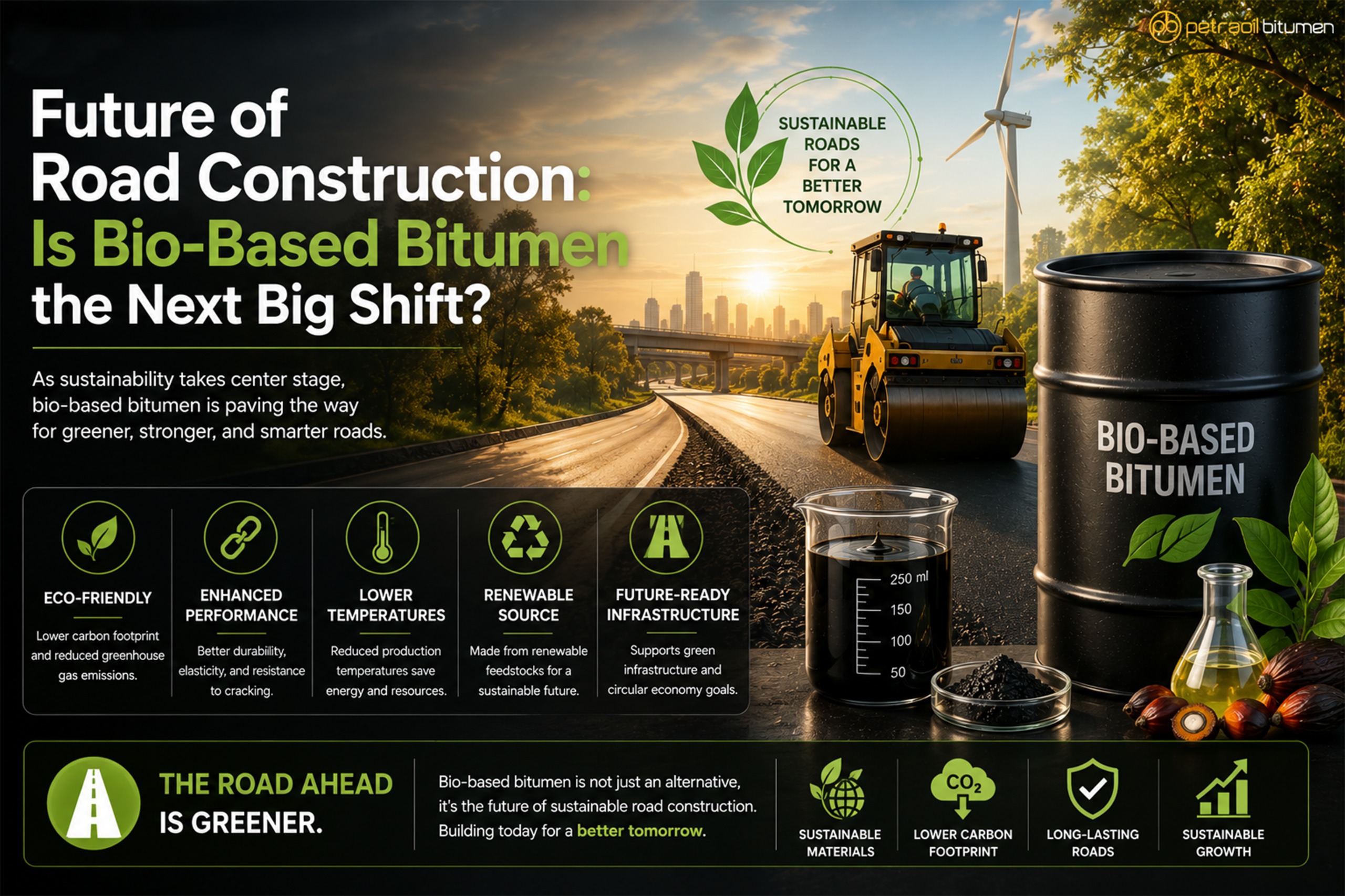
The road construction industry is entering a new age, driven by increasing environmental awareness, more stringent rules and the global search for sustainable infrastructure. Governments, contractors, and material suppliers are seeking for solutions that cut carbon emissions without sacrificing road performance. Petroleum based bitumen is still the main component of modern asphalt pavements, but the last decade has seen a surge in research into other binders.
One of the emerging breakthroughs drawing much attention is bio-based bitumen. Bio-based binders are derived from renewable resources, rather than crude oil, and may help reduce dependence on fossil fuels and help meet sustainable long term goals. But will they truly replace conventional bitumen, or will they only supplement existing products?
This article delves into what bio-based bitumen is, its benefits, current challenges and if it’s the future of road building.
What Is Bio-Based Bitumen?
Bio-based bitumen is a binder that is produced from renewable biological materials rather than from petroleum and can be partially or fully bio-based. These materials may consist of:
- Lignin from the paper and pulp industry
- Vegetable oils
- Tall oil from wood processing
- Agricultural waste
- Sugar industry byproducts
- Biomass-derived residues
Traditional bitumen is a byproduct of the crude oil refining process. Bio-based alternatives are meant to limit the dependence on limited fossil resources and to reduce the environmental impact of asphalt production.
In most of the current applications, bio-based materials are mixed with conventional bitumen, not used as a direct replacement. This hybrid approach enables manufacturers to improve sustainability while maintaining the performance characteristics needed for challenging road projects.
Why Is the Industry Exploring Bio-Based Alternatives?
Several global trends are driving interest in renewable binders and asphalt mixes.
Sustainability Targets
Many countries have committed to reducing greenhouse gas emissions thru national climate policies. Road building has a big impact on infrastructure related emissions and hence the focus is on innovation in asphalt production. We can lower carbon footprint in pavement building by substituting some of the petroleum based bitumen with renewable resources.
Circular Economy
Bio-based binders often rely on industrial or agricultural waste that otherwise have limited commercial value. By converting these resources into road building products, we are creating new value chains and minimising waste, therefore supporting the principles of the circular economy.
Reducing Dependence on Crude Oil
Bitumen prices are mostly tied to movements in crude oil markets, which can be quite volatile. Diversifying the sources of raw materials could improve the durability of long term supply and lessen the dependence on petroleum.
Increasing Demand for Green Infrastructure
Governments, municipalities and private developers are increasingly looking to procure environmentally appropriate construction materials. Sustainable asphalt solutions are proving to be an increasingly crucial differentiator in infrastructure projects.
Potential Benefits of Bio-Based Bitumen
Bio-based bitumen has several promising advantages, although it is still under development in many regions.
Lower Environmental Impact
The main benefit is the potential for reducing carbon emissions over the life cycle. Depending on the feedstock source and production process, renewable feedstocks have the potential to contribute to a decrease of greenhouse gas emissions relative to binders that are exclusively petroleum based.
Improved Resource Efficiency
Renewable and recycled raw materials save natural resources and decrease waste to landfill or incineration.
Compatibility with Existing Asphalt Technology
The bio-based binders can be included into conventional asphalt production processes with minimal modification. This reduces the need for massive expenditures in new infrastructure.
Enhanced Innovation Opportunities
Research continues to explore formulations that improve:
- Durability
- Ageing resistance
- Flexibility
- Resistance to cracking
- Performance at low temperatures
Some bio-based additives have shown positive experimental results in improving specific pavement qualities.
Current Challenges
Interest is growing, but bio-based bitumen is not yet ready for global replacement of conventional bitumen.
Performance Consistency
One of the big challenges is to create uniform performance from various bio-based feedstocks. Biological materials exhibit natural variation which can make consistent product quality challenging.
Infrastructure projects require binders that meet strict engineering standards and can perform for decades of service life.
Large Scale Production
Global demand for bitumen continues to be strong relative to current production volumes. The challenge of scaling up production to maintain quality and cost competitiveness remains.
Long Term Field Performance
Laboratory testing has shown promising results, but many bio-based formulations still require extensive long-term field validation under different climates and traffic conditions.
Road authorities generally require materials to perform for decades before they are used widely for infrastructure projects.
Cost Considerations
Many bio-based binders are still more expensive than conventional bitumen due to limited production capacity and developing manufacturing processes.
As the technology matures and economies of scale are improved, the production costs are expected to be more competitive.
The Role of Conventional Bitumen in the Coming Years
Although more sustainable initiatives are underway, conventional bitumen will continue to be an essential material in road construction for the foreseeable future.
There is an increasing global need for infrastructure, especially in the developing economies, and hence the need for cost-effective and durable road materials.
Industry experts anticipate a change, not a wholesale shift, to:
- Partial bio-based blends
- Modified binders with renewable additives
- Lower-carbon asphalt technologies
- Warm mix asphalt solutions
- Increased recycling of reclaimed asphalt pavement (RAP)
This balanced approach enables the industry to reduce environmental impact while maintaining the performance standards expected from modern pavements.
What This Means for Bitumen Suppliers
The work on bio-based bitumen shows the need for continuous innovation along the supply chain.
Forward-thinking suppliers can prepare by:
- Monitoring advancements in renewable binder technologies
- Investing in research and development
- Supporting customers with sustainable product options
- Staying informed about evolving environmental regulations
- Maintaining high quality conventional products while exploring future alternatives
This balanced approach helps the industry to reduce its environmental footprint while still meeting the performance standards expected from modern pavements.
Looking Ahead
Bio-based bitumen is one of the most exciting developments in sustainable road construction. In the near term it is not expected to replace conventional bitumen but rather is likely to become an increasingly important component of next generation asphalt technologies.
With additional research, more production and more performance data, renewable binders could have a bigger role in helping the construction industry achieve its environmental goals.
In the future, infrastructure owners, contractors and suppliers will have to combine proven conventional materials with innovative sustainable solutions to build longer lasting, lower impact roads.
Conclusion
The shift to greener infrastructure is transforming the road construction industry and bio-based bitumen is proving to be a promising contributor to that transformation. But while there are technical and commercial challenges, ongoing research suggests that renewable binders could play an important role in future pavement solutions. products will be well placed to address the changing needs of the global infrastructure industry.
For infrastructure projects today, choosing a dependable bitumen supplier remains just as important as keeping an eye on what comes next. At PetraOil, we continue to focus on supplying quality bitumen solutions that meet the demands of modern road construction while keeping pace with the industry’s evolving needs. If you’re planning a project or exploring the right bitumen grade for your application, our team is always happy to discuss your requirements.
